DECISION-MAKING UNDER UNCERTAINTY
The Quantum Cognition Science That Changes
Everything
By Dr Perry Zeus — Pioneer of Behavioural Coaching ·
Founder, Dr Zeus's Quantum Coaching Institute
The most dangerous moment in executive leadership is
not when a decision is wrong. It is when a decision
is made too early — with false confidence — before
the situation has revealed what it actually
requires.
In the AI workplace this moment is happening
constantly. And the science explains precisely why.
THE CERTAINTY TRAP
Most leadership development trains leaders to make
decisions. To be decisive. To project confidence. To
move from ambiguity to clarity as quickly as
possible.
This was reasonable advice for stable environments
where speed of decision was a genuine competitive
advantage.
In genuinely complex environments — where cause and
effect are nonlinear, where the situation is
evolving faster than the data, and where premature
certainty is more dangerous than honest uncertainty
— it is actively harmful advice.
The leaders who perform best under uncertainty are
not those who decide fastest. They are those who can
hold the question open longest — without losing
coherence, direction, or team confidence.
This capability has a name in the Quantum Leadership
Framework: Uncertainty Tolerance. And the science
behind it changes everything about how we develop
leaders for the AI era.
WHAT QUANTUM COGNITION REVEALS
Jerome Busemeyer and Peter Bruza's peer-reviewed
Quantum Cognition research at Indiana University
demonstrates something that classical decision
science has never been able to explain: human
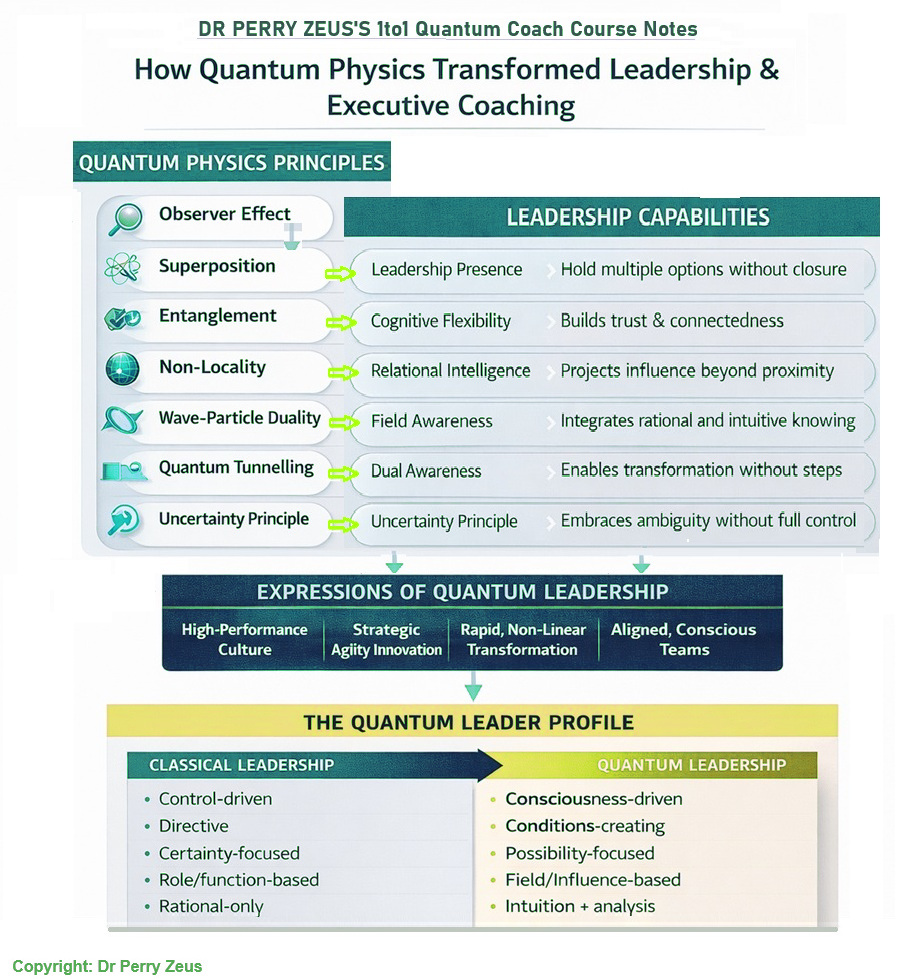
cognitive states exist in superposition.
Multiple contradictory possibilities are held
simultaneously in the human mind — until the moment
of decision collapses them into a single outcome.
This is not a metaphor. It is the mathematical
framework that most accurately describes how human
decision-making actually works.
The practical leadership implication is profound:
premature decision closure is not decisiveness. It
is the collapse of cognitive superposition driven by
the neural discomfort of uncertainty — not by
genuine strategic clarity.
A leader who closes options early because the
ambiguity is uncomfortable is not making a better
decision. They are making an earlier one — from a
narrower field of possibilities — driven by
decoherence rather than insight.
WHAT NEURAL DECOHERENCE DOES TO DECISION QUALITY
Cognitive neuroscience is equally precise about what
happens to the leadership brain under uncertainty.
Amy Arnsten's research at Yale demonstrates that
even moderate stress significantly impairs
prefrontal cortex function — the neural seat of
strategic reasoning, working memory, and cognitive
flexibility. Under genuine uncertainty the
prefrontal cortex is compromised at exactly the
moment it is most needed.
Simultaneously the amygdala — the brain's
threat-detection system — drives the leader toward
fast, familiar, pattern-based responses. Not because
those responses are strategically correct. Because
they reduce the neural discomfort of uncertainty.
The result: decisions that feel confident and
decisive — and are systematically biased toward the
familiar, the fast, and the certain — regardless of
whether the situation calls for any of those things.
This is neural decoherence in action. And it is
epidemic in the AI workplace.
THE THREE DECISION FAILURES DECOHERENCE PRODUCES
Premature closure
— deciding before the situation has revealed what it
actually requires. The leader reduces cognitive
discomfort by collapsing options — mistaking the
relief of decision for the clarity of insight.
Pattern imposition
— applying yesterday's solution to today's genuinely
novel problem. The decoherent brain defaults to
familiar patterns because novelty requires the
prefrontal flexibility that decoherence has
impaired.
False certainty
— projecting confidence that is not grounded in
genuine strategic clarity. The leader performs
decisiveness for the team while the underlying
decoherence continues to compromise their actual
decision quality.
All three are invisible from the outside. They look
like leadership. They feel like leadership. But they
are the outputs of a decoherent neural system
responding to uncertainty with the cognitive
equivalent of fight or flight.
WHAT GENUINE UNCERTAINTY TOLERANCE LOOKS LIKE
The leader who has developed genuine Uncertainty
Tolerance — through decoherence reduction and
quantum coherence restoration — operates differently
in every dimension:
They remain strategically patient when the situation
is genuinely uncertain — holding the question open
until clarity actually emerges rather than
manufacturing it prematurely.
They read the specific situation with fresh
perception rather than filtering it through familiar
patterns — accessing the full field of available
information rather than the narrowed field that
decoherence produces.
They communicate honest uncertainty to their team in
ways that maintain direction and confidence — rather
than projecting false certainty that the team can
sense is not genuine.
They access superconscious intelligence — the
quantum intuitive signal that arrives before the
analytical data — and integrate it with rigorous
analysis rather than suppressing it as
unprofessional.
The difference between these two leaders is not
intelligence, experience, or strategic capability.
It is the quality of their neural coherence under
pressure.
THE DEVELOPMENT QUESTION
Traditional leadership development cannot address
this gap — because it works at the surface level of
decision-making frameworks and conscious strategy,
leaving the underlying neural decoherence untouched.
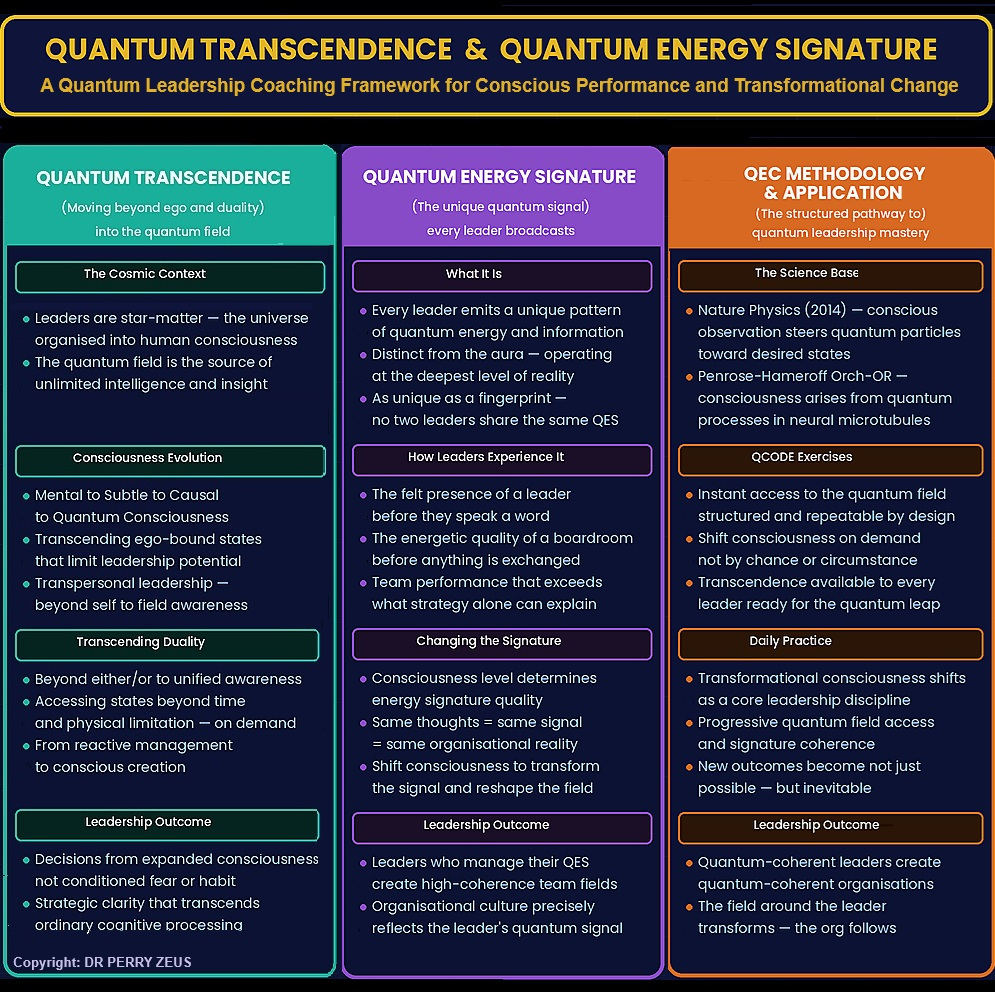
The Q-Code methodology — specifically the ES
(Emotional SmartChange) Model — dissolves the
specific subconscious programs generating the
leader's decoherence response to uncertainty. Not
through coping strategies layered on top. Through
genuine quantum energy root dissolution that
produces permanent neural coherence restoration.
The result: a leader who can maintain strategic
clarity and genuine Uncertainty Tolerance under the
conditions of complexity that the AI workplace
generates — not occasionally, but reliably and
sustainably.
"The leaders who will define the AI era are not
those who process information fastest. They are
those who maintain quantum coherence under the most
intense uncertainty — accessing the level of
consciousness from which genuinely great decisions
actually emerge."
— Dr Perry Zeus
THE DIAGNOSTIC QUESTION
How many of your senior leaders are currently making
decisions that feel decisive — but are actually
driven by neural decoherence responses to
uncertainty rather than by genuine strategic
clarity?
The answer to that question defines the most
important leadership development investment your
organisation can make right now.
→
Explore the Quantum Leadership
Framework
→
View the QEC
Certification Program
→
Read Also: Why
Traditional
Leadership
Models
Fall in AI Era
Copyright © Perry Zeus · Dr Zeus's Quantum Coaching
Institute · 2026
Index Page >